
Scratch Your Own Itch (And Then Everyone Else’s)
In the late 1950s, the Cold War was less of a "chill" and more of a high-stakes game of "who has the bigger firecracker." Scattered across the American landscape were deep, concrete-lined caverns housing Atlas Intercontinental Ballistic Missiles (ICBMs).
These weren't just rockets. They were the apex of 1950s engineering, essentially giant pressurized steel balloons filled with liquid oxygen and kerosene. They were designed to sit in dark, damp silos, waiting for a day everyone hoped wouldn't come.
The Problem: Rust Never Sleeps (Even in a Nuclear Bunker)
While steel is fantastic for structural integrity, it has a mortal enemy: moisture.
A missile silo is basically a giant underground humidity chamber. The Atlas missiles were prone to corrosion, and a rusty ICBM is about as useful as a chocolate teapot, only significantly more explosive. The military realized that if they didn't find a way to keep the dampness off the "birds," their multi-million dollar deterrent would turn into a collection of very expensive lawn ornaments.
Enter: Rocket Chemical Company
In 1953, a tiny outfit in San Diego called Rocket Chemical Company took on the contract. The mission was simple: create a water-displacement solvent to coat the missile skin, prevent rust, and keep the electronics from short-circuiting.
The staff consisted of exactly three people. There were no massive R&D labs or coffee bars. It was just three guys, some chemicals, and a dream of non-corrosive weaponry.
Trial, Error, and a Lot of Scrubbing
They didn't get it right on the first try. Or the tenth. Or even the thirty-ninth. They spent weeks mixing, testing, and failing.
Attempt #1: Probably smelled like old socks and evaporated in minutes.
Attempt #15: Likely turned into a weird goo that attracted more dust.
Attempt #39: Almost there, but just couldn't quite beat a foggy day.
Finally, on their 40th attempt, the chemistry gods smiled. They perfected a "Water Displacement" formula that worked flawlessly. The military was thrilled, the missiles were shiny, and the world remained relatively safe.
The Pivot: From Nukes to Squeaky Hinges
Most companies would have finished the contract, cashed the check, and closed up shop. But Norm Larsen, the founder, noticed something interesting.
His employees weren't just using the stuff on missiles. They were "liberating" small vials of the compound to take home. They used it to fix the squeak in the screen door, lube up the gears on their kids' bikes, and unstick the junk drawers that hadn't opened since the Truman administration.
Larsen realized that while the military’s demand for missile coating was finite, the world’s demand for "making stuff move" was infinite.
The Naming Ceremony: Since it was a Water Displacement formula perfected on the 40th try, Larsen gave it the most literal name in marketing history: WD-40.
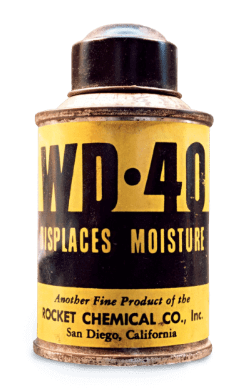
The Moral of the Story: Leading with Curiosity
The transition from a specialized military solvent to a household staple didn't just happen because the chemistry was right. It happened because the culture was right. There are several leadership lessons hidden in that blue-and-yellow can.
1. Keep Your Eyes Open (and Your Ego Small)
Norm Larsen didn't look at his staff using the product at home and say, "Stop stealing company property." He looked and asked, "Why?" Innovation rarely comes from a formal brainstorming session. It usually comes from watching how people solve their own frustrations. When you see a "workaround," you're looking at a new product in disguise.
2. Courage is the Catalyst
It takes courage to suggest that a product designed for nuclear defense belongs under a kitchen sink. In many companies, that idea would have been laughed out of the room. Encourage your team to speak up, especially when the idea sounds a little "out there." The leap from ICBMs to squeaky hinges required a culture that treated a crazy observation as a legitimate lead.
3. Ideas Have Merit, Not Rank
The best idea in the room rarely cares about the title of the person who had it. Whether it's the CEO, a chemist, or the person sweeping the lab floor, ideas should be judged on their potential, not their pedigree. If you only listen to the most "experienced" voices, you'll only ever get "experienced" results. WD-40 was the result of three people tinkering, a flat hierarchy where the 40th attempt was celebrated, not mocked as a 39-time failure.
4. Create an "Idea Sandbox"
To get a WD-40, you have to be willing to sit through Versions 1 through 39. Establish forums where ideas can be mooted, not to be approved or rejected immediately, but to receive curious questions.
Instead of saying, "That's too expensive," ask: "How could we make this cost-effective?"
Instead of saying, "That's not our market," ask: "Who else besides the military struggles with rust?"
This curiosity-first approach educates and emboldens staff. It transforms a critique into a collaboration.
5. There Is No Such Thing as a Bad Idea
In the world of innovation, a "bad" idea is often just a "half-baked" one. An idea you don't run with might be the exact spark someone else needs to find the winning solution. If the team hadn't been allowed to fail 39 times, they never would've reached the 40th. Every "no" is just a data point leading you closer to the "yes."
The Power of the Pivot: You’re in Good Company
The story of WD-40 is a masterclass in serendipity, but it certainly isn't an isolated case. History is littered with "accidents" that changed the world because someone was paying attention.
Penicillin: Alexander Fleming wasn't trying to save the world from infection. He just left a petri dish out while he went on vacation and noticed the mold was "acting funny."
X-Rays: Wilhelm Roentgen was busy studying cathode rays when he noticed a fluorescent screen across the room glowing. Instead of ignoring it, he put his hand in front of the beam and saw his own bones.
Vulcanized Rubber: Charles Goodyear spent years failing to stabilize rubber until he accidentally dropped a mixture of rubber and sulfur onto a hot stove. Instead of melting, it hardened.
None of these breakthroughs was the original objective. They were the "scratched itches" of people who were brave enough to pivot when the data told them to.
Can you be the next Fleming, Roentgen, or Goodyear? It starts with being open to new ideas from the most unlikely of places and the most unlikely of people. As Douglas Adams famously wrote, "Expect the unexpected!"
Don't just look for the result you planned. Look for the result that's actually happening. Your next missile solvent might just be the world's next household hero.